

Refer a Patient
Interventional treatment for depression and OCD, for patients not improving on medication and therapy alone. Your patient remains under your care throughout. We are a TMS-only clinic and a specialty resource, not a competing practice.
Or call 720-446-8675

One Psychiatrist,
One Treatment.
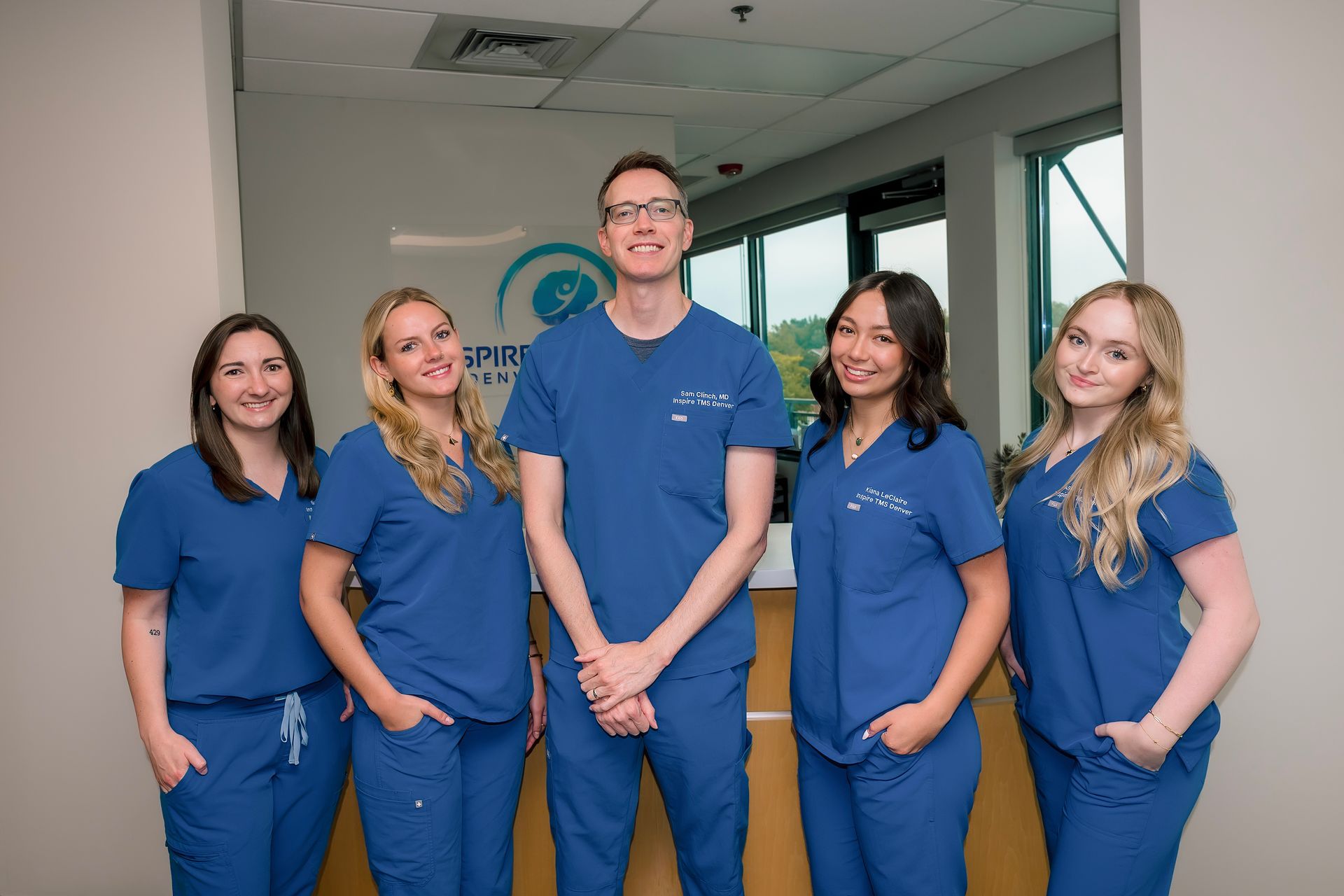
Sam Clinch, MD
Board-certified psychiatrist · Founder and Medical Director
Dr. Clinch has practised psychiatry for over ten years and founded Inspire TMS Denver to focus on one treatment rather than offer it alongside everything else. He carries out the motor threshold mapping and sets the protocol himself, so treatment decisions are made by a physician rather than delegated.
Over 15,000 TMS treatments have been delivered at the clinic to date.
Two Minutes.
We Take it From There
All referrals are HIPAA-compliant and encrypted
Whichever Fits Your Practice.
The form above is the fastest route and the one we can track properly, but it is not the only one.
What Happens To Your Patient.
We contact them and check benefits
Our team handles intake, verifies the plan and submits the prior authorization. Nothing lands on your front desk.
Free consultation with Dr. Clinch
10 to 15 minutes on history, prior trials and which protocol fits. Standard, 5-day accelerated or single-day ONE-D is a clinical decision.
Treatment, scored throughout
Physician-led mapping, MagVenture equipment, standardised scoring during the course rather than only at the end.
Records available to you on request
Treatment records and summaries are available to the referring provider on request, with patient authorization.
Who To Refer, And Who Not To.
We would rather tell you a patient is not a fit than take the referral and find out later.
- Adults with MDD who have not responded to two or more antidepressants from different classes
- Patients who respond to medication but cannot tolerate the side effects
- OCD, as augmentation alongside existing treatment
- Patients who cannot commit to six weeks of daily visits
- Ferromagnetic implants or devices in or near the head
- Seizure history, or anything lowering seizure threshold
- Active suicidal crisis needing inpatient stabilisation
- Active substance dependence requiring detox first
Frequently Asked Questions
How long is a course of treatment?
It depends on the protocol. Standard TMS runs daily sessions across roughly six weeks. Accelerated compresses the same number of sessions into five days. ONE-D delivers a course across a single day. Which one fits is a clinical decision made at consultation, not a patient preference.
Does my patient need to stop or change their medication?
No. TMS is delivered alongside existing treatment, and we do not prescribe. Their regimen stays yours to manage. If you are planning changes during the treatment window it is worth telling us, so scoring can be interpreted properly.
What should I tell them to expect?
Sessions are carried out awake, with no sedation and no recovery time. Patients drive themselves home and go back to work the same day. Side effects are limited and localised, most commonly scalp discomfort at the treatment site and headache. Seizure is a rare risk with any TMS system. We treat with MagVenture targeted figure-of-eight coils rather than a deep coil, and seizure incidence has been reported as higher with deep TMS systems (Taylor et al., 2021), which is worth weighing for any patient with risk factors.
Does a patient need a formal referral letter?
No. Prior authorization generally needs documentation of previous medication trials, but that can come from records sent separately. A letter speeds things up, it is not required.
How soon can they start?
Your patient usually speaks to Dr. Clinch within a day of getting in touch. From there the pace is set by the benefits check and prior authorization rather than by our schedule, and self-pay courses avoid that wait entirely. The clinic has capacity for new patients at present.
What if they do not respond?
Not everyone does. Scoring runs throughout the course rather than only at the end, so a patient who is not moving is identified during treatment rather than after it. Retreatment and protocol changes are common, and roughly 80 to 90 per cent of patients who return for a repeat course respond again. We have written about this in more detail here.
Can I discuss a case before referring?
Yes. Call the clinic on 720-446-8675 and the team will arrange it.